
Residents demand action on water issues
By Kadie Taylor
The LaFayette Sun
LaFayette mayor, city council members and citizens gathered on Wednesday, Feb. 25, for a Town Hall Meeting to discuss the water infrastructure — with Dr. Travis “Tee” Smith as the moderator.
City of LaFayette Superintendent over water distribution, Allen Garrett, shared his perspective on the water infrastructure concerns and said he believes it is necessary to replace all of the pipes that are believed to be contributing to the discolored water issues.
“When I was promoted to superintendent, one of the big topics that we discussed was the dirty water/discoloration,” he said. “I've been able to remove most of it by flushing weekly. Weekly flushing has drastically reduced the calls coming to City Hall. After saying all that, I would also like to tell you about the system we have here. It's called a loop system, which means exactly what it's called — the water travels in a loop. All the water lines are tied together. There's no possible way that we can replace just one line and the whole problem goes away — that's not going to happen. As you have been told and obviously shown, there is tuberculation in the cast iron pipe. This is common for cast iron; the photos you have seen were taken from a pipe that was moved from Avenue A. And a portion of that pipe was repaired. There are approximately 6.6 miles of cast iron pipe that desperately needs to be replaced. This is an issue, and that's the only way that we're going to change the city’s discoloration problem: removing all of it. For this to happen, it must be tackled in phases, phases that I believe will stretch out over the next five, possibly even 10 years. The line under 431 will be the most expensive and extensive to replace.”
Representatives from Harmon Engineering — Austin Harmon, Collin Sharpe and Allen Tucker — shared information they gathered when looking at grants and talking with ALDOT. Tucker said the discoloration is not harmful to locals’ health and explained how it occurs.
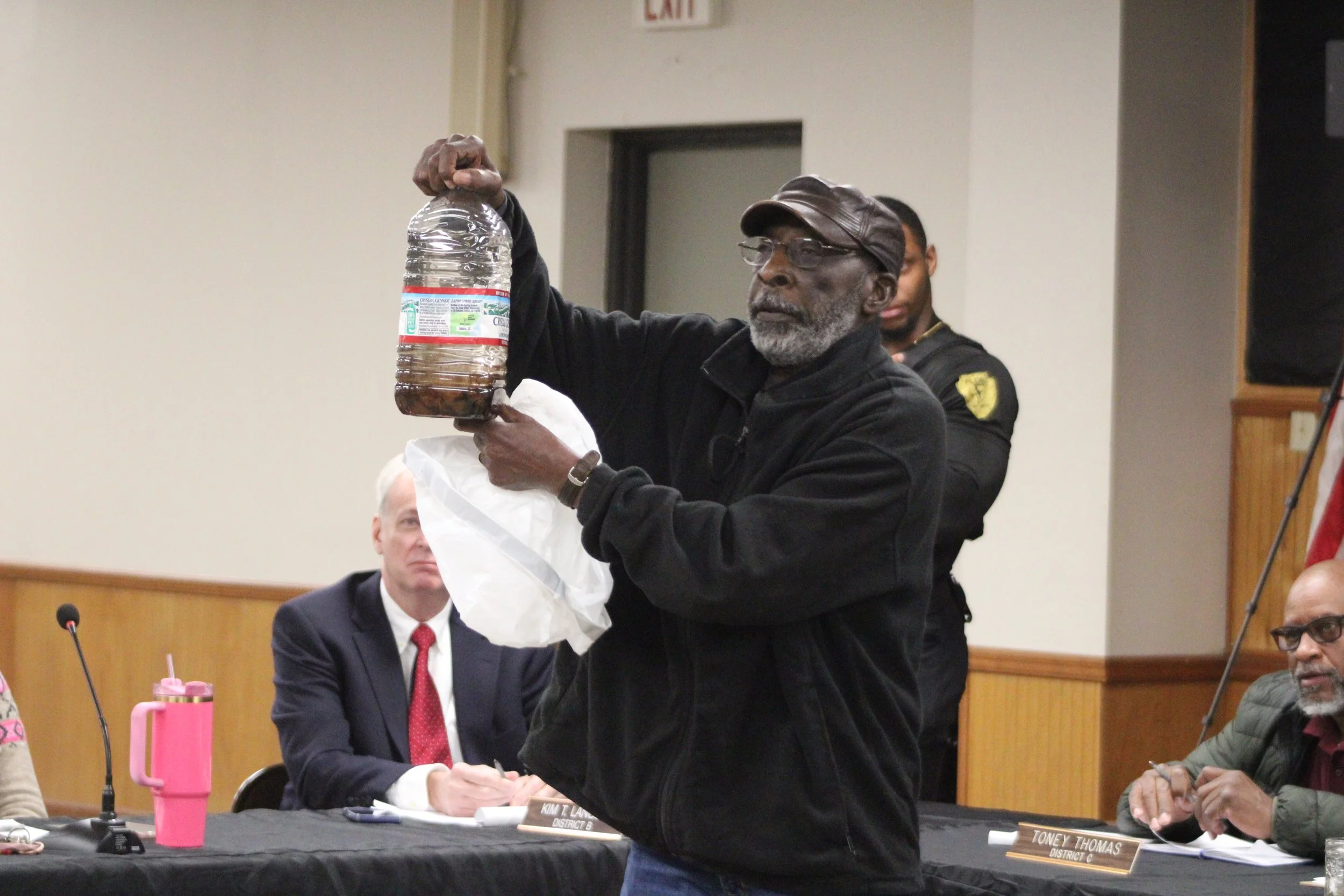
“I want to discuss the source of the brown water a little bit further,” he said. “Our water comes from the city reservoir — that's a 100-acre reservoir — that is built in a soil formation in the watershed to that lake, which is rich in a mineral called manganese. This manganese dissolves in water easily, but it is difficult to remove. So this accumulated manganese is taken out in the plant, but small amounts of it slip by over time, settle out and accumulate in the pipe. The six-inch cast iron pipe is a lot worse because it's got the tuberculation in it, and all the little pockets that the stuff that this manganese and iron oxide rust settles out in. Any time there is a disruption, an open fire hydrant, a break, a leak or whatever, [it picks this mineral] up and it dissolves in the water and makes it tea-colored, brown or worse. So that's the primary source of that brown water, and this manganese doesn’t hurt you physically, because it's a mineral that is added to your multivitamin.”
Tucker also said it is important to move the waterline out from under Highway 431 downtown, as the large trucks and high-rates of traffic can disturb the pipe and could threaten its stability.
“[The water line] is also subject to vibration and the pounding of all these trucks coming through there,” he said. “That particular cast iron line — we suspected it's lead-jointed pipe — which means it's not bolted together, it's just joints that are sealed with lead. That vibration is probably causing it to leak, and when [ALDOT] comes through to put the paving on [they will] use that vibratory roller to compact the asphalt. Some other reasons, the pipe is six-inch, it's got that tuberculation in it, so it's probably restricted to about a four-inch pipe equivalent — which severely reduces fire flow. That's one of the reasons to replace it in the downtown area, because the fire flow is severely restricted in the downtown area.”
City Clerk Lewis Davidson said the city of LaFayette has not raised water rates regularly in the past three decades, and rate increases would likely be necessary to enable a comprehensive plan to fix the water infrastructure. For the city to fund the cost, Davidson said he was told it would take $2.1 million for the Highway 431 project; he said if no grants were received, rates would increase by $12.17 per customer per month. If $900,000 of previously-identified grants were received, making the project cost $1.2 million, Davidson said the rates would increase by $6.95 per customer per month.
Lewis also said that while the city has $2 million in a CD, the interest made from that CD is considered in the revenue projections for the city budget, and having reserves for unexpected emergencies is important.
“Some of that money we consider as reserves too,” he said. “You've got to have reserves, because you never know when a rainy day is going to happen. So you can say the CD is $2 million, but if you take the entire $2 million and use it on the project, and then all of a sudden [if there is an emergency] — like when I was hired in two 2008 we were in the middle of a financial crisis, and all of a sudden, sales tax dipped and all this stuff dipped. Then the city was kind of in touch spot, but we did survive. But if you have a situation like that, and you don't have anything to fall back on [it is not a good situation]. So, some of that funding, you want to keep it for a rainy day, because in the future,you don't know when it's gonna happen — but you know at some point it's gonna happen.”
Constituents who signed up at the beginning of the meeting were each given two minutes to speak; 13 constituents shared their experiences and perspectives on the water infrastructure issues and the split decision that resulted in not approving or committing to the downtown Highway 431 water line replacement project.
Multiple speakers brought examples of what the water looks like, from posters to water filters, and presented their concerns over the health of locals, the growth of the city and the need for a comprehensive plan to solve the water infrastructure issues.
“I think everybody in this room is willing to pay a higher water [bill] if they had something they could drink,” said David Howard. “We're spending way more than $5 a month on bottled water. Again, I think the anger comes from inaction. The anger comes from kicking the can down the road… The council's failure to move on this project is a clear signal of how they will move forward on other infrastructure projects, excuses about cost, complaints that it is not beneficial to certain districts, personal agendas and vendettas and roadblocks. LaFayette has been held back by these antics for two decades — three, really, now that we're talking about it — and it’s time to change.”
“Why are we just now trying to get something done?” said Nathaniel Henderson. “Leaders, y'all need to lead, just like anywhere else. Leaders are here to lead, and that's what we expect as a city. Anybody who has a leadership role in their job is expected to lead. And then something else that I would like to touch on, man, you've got to spend money to make money. There's a lot of potential here in the city of LaFayette. There are a lot of businesses that we could get to come in here. There are probably a lot of people who own franchises that would like to come here and would like to feed us and do other things restaurant-wise. But we’ve got to take the initiative, to make the stand, to do something about it and fix what we need to fix here. We have to take control first — the money will come.”
“I ran for city council this year, and I ran because I'm concerned about the city, I'm concerned about the growth of the city and I want to be a part of the growth of the city,” said Nell Finley. “I wanted to sit at the table and work with the mayor and council so that we can come to a comprehensive agreement, that we wouldn't fight each other, and we would talk together when we come to this table — [and remember that] we're representing the whole city, not just [our own] districts. I ran District B. Mr. Langley has the district, and I'm watching him all the way. I want to say that when you run for public office, you're working for the people. When there is an issue of concern, my question is, how many times have you considered bringing the citizens to a meeting like this to let us know that it's time for you to propose a rate increase on water? And I don't think nobody in this room would argue with that. My water went from brown and now it's milky white. My water comes out like it's got milk in it, and it settles, and then it clears up. I gotta take a bath in there. If I'm cooking, I gotta cook. We're spending money on water. Why can't we get an increase on our water prices if it's going to help the city do what you got to do? If you want to make a decision yourself to increase, why can't you talk to us as citizens and let us have an input on the decisions that you make? Because you're working for us, we’re not working for ya’ll… And we do need to know why you vote the way you vote — I think that you owe that to us as citizens.”
Smith closed the meeting by thanking locals for attending. He also said it is important for the council and mayor to work together as they move forward with navigating and updating the water infrastructure and said he wants to encourage regular town hall meetings.
“We can't allow issues to be the only time the city comes together to commune; that is not a healthy indicator of a growing city,” he said. “Also, water is not a right; it's a human necessity. Everybody needs water to live and to be healthy, so it's not a question of what should happen; it's a question of when it should happen, and it should be happening tomorrow. Then lastly, although I did pitch a comprehensive plan around phases, I do want people to understand that people are going to be left out in phases. Everybody can't be in phase one; everybody won't be in phase two and everybody won't be in phase three. So people are still going to be upset. [The focus is] can we see a total plan? Can we see the grounds being cracked? Can we see the buildings going up? That's what I think is the overall message is from today. Can this council and mayor get on one accord and agree on the steps of action going forward? Thank you all so much for coming out. Thank you for voicing your concerns. Please do not let this be the only time that you speak to your representatives or the mayor. You elected these individuals to represent your voice, and they should be held accountable with their votes and with their actions.”
